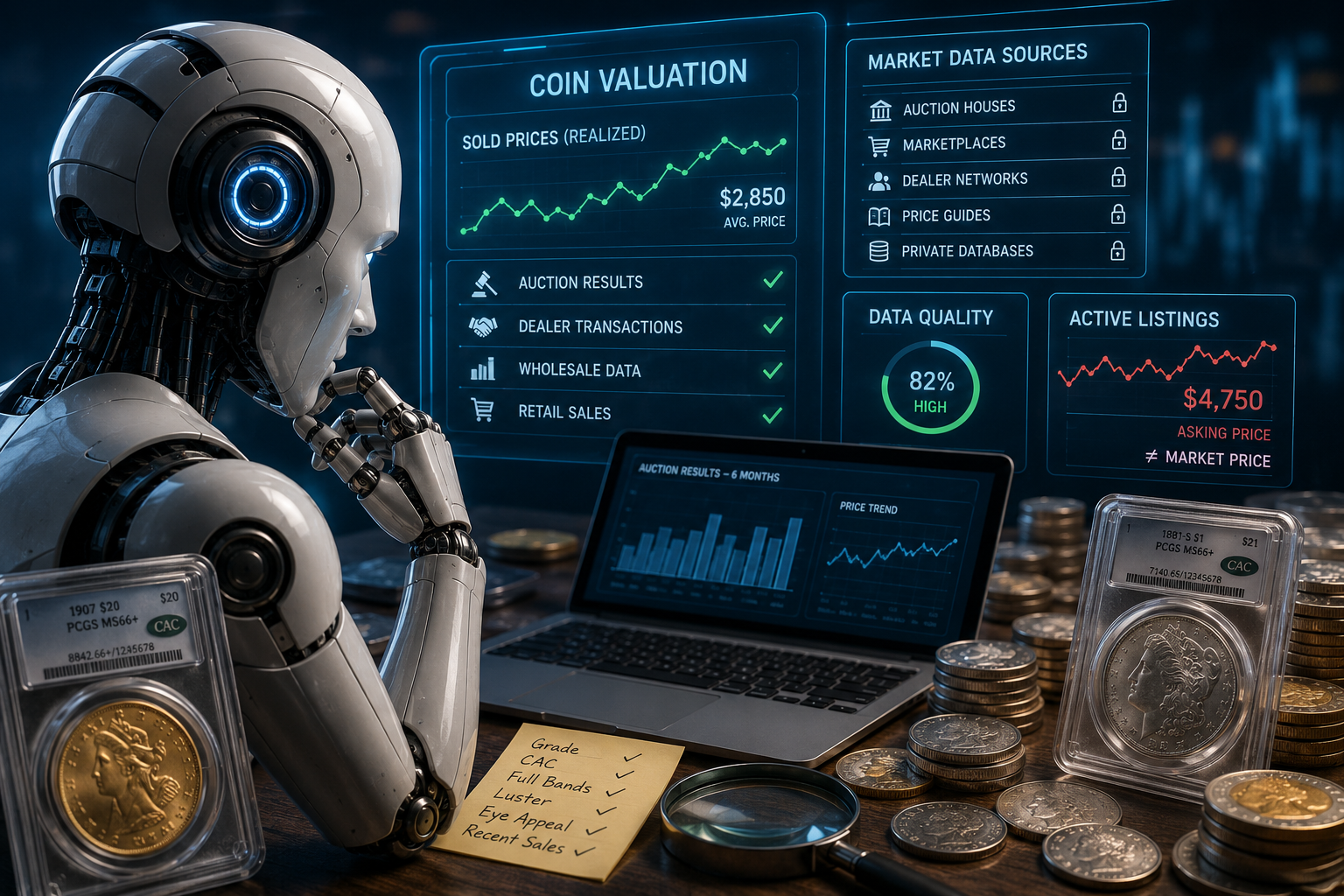
Many collectors assume AI can instantly determine a coin's value, but accurate pricing depends on access to reliable market data. This article explores why AI struggles with coin valuation when sold-price records are restricted, incomplete, or unavailable. It explains the difference between asking prices and actual sales, the importance of coin-specific attributes, and why human expertise still matters. The article argues that the most accurate valuations come from combining AI with curated auction records, dealer transactions, wholesale data, and real-world numismatic knowledge.
If you've spent any time online lately, you've probably seen people asking AI tools to value their coins.
Upload a photo. Ask a question. Get a number.
It sounds simple.
The problem is that coin pricing has never been simple, and AI doesn't magically solve the biggest challenge in numismatics: access to accurate market data.
AI can be an excellent research tool. It can identify coins, summarize information, and help collectors understand grading terminology. But when it comes to determining market value, the answer is only as good as the data available behind the scenes.
AI doesn't possess a secret database of coin values.
Instead, it gathers information from sources it can see and access. If the underlying sales data is incomplete, outdated, or unavailable, the valuation will reflect those limitations.
This becomes increasingly important as more auction houses and marketplaces restrict access to realized-price records. Many of the most valuable sources of transaction data are now behind paywalls, subscription services, or proprietary databases.
When AI cannot see the actual sales history, it must rely on whatever public information remains available.
That's where problems begin.
One of the most common mistakes AI makes is confusing listings with sales.
Just because a seller is asking $5,000 for a coin does not mean anyone is willing to pay $5,000 for it.
Collectors see this every day on online marketplaces. Some coins sit unsold for months or years because the asking price is unrealistic.
Real market value comes from completed transactions, not seller expectations.
An accurate valuation requires understanding the difference between:
These are all different markets, often with very different pricing.
A small detail can dramatically change a coin's value.
Consider the difference between:
Two coins that appear nearly identical to a casual observer may trade hundreds or even thousands of dollars apart.
Before AI can estimate value, it must first identify all of these attributes correctly.
That's not always easy.
Even when sold-price data is available, it still requires interpretation.
Many databases contain:
A knowledgeable dealer or collector naturally filters these examples.
AI often lacks the context to determine which sales are truly comparable and which should be ignored.
Many certified coins simply don't trade very often.
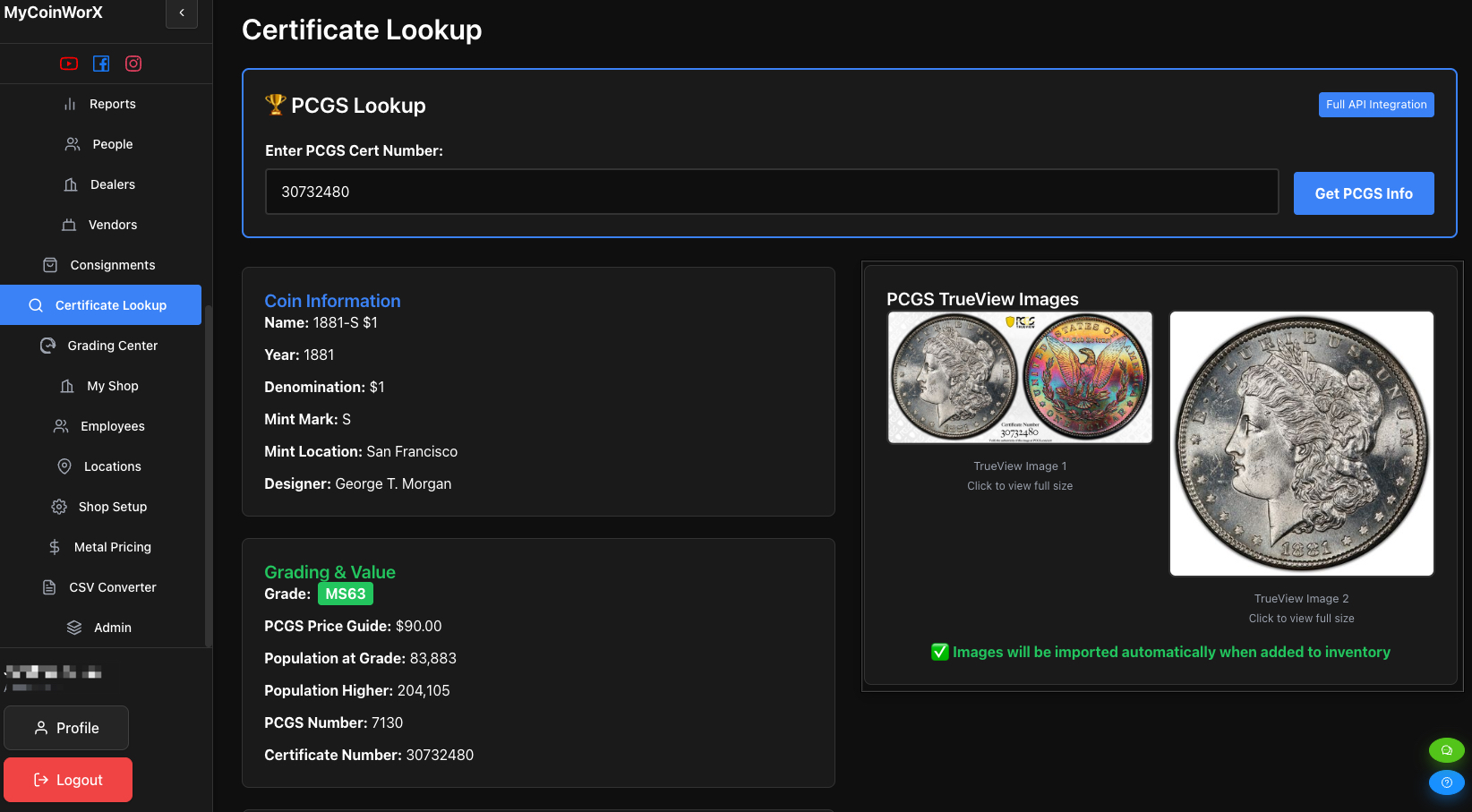
A common-date Morgan Dollar in MS63 may have hundreds of recent sales available for analysis.
A scarce variety, condition rarity, or specialized series may have only one public sale in several years—or none at all.
When no recent transactions exist, AI has little evidence from which to build an estimate.
In these situations, experience and market knowledge become far more important than algorithms.
Collectors often ask, "What's this coin worth?"
The answer depends on who is buying it.
A wholesaler may pay one amount.
A retail dealer may ask another.
An auction bidder may pay something entirely different.
A registry-set collector chasing a top-ranked set may pay more than any published guide suggests.
Market value is often a range, not a fixed number.
AI-generated estimates frequently miss this nuance.
Some of the most important characteristics affecting value aren't easily captured in a database.
Experienced collectors evaluate factors such as:
Two coins with identical grades can bring dramatically different prices because of these characteristics.
No pricing model can fully replace human judgment in these areas.
The discussion around AI pricing often focuses on the technology.
In reality, the biggest advantage comes from access to high-quality market data.
Proprietary pricing systems built from verified auction records, dealer transactions, wholesale activity, and historical sales provide insights that public searches simply cannot match.
The difference is not the algorithm.
The difference is the information feeding the algorithm.
AI absolutely has a role in numismatics.
It can help collectors identify coins, organize information, summarize market activity, and improve research efficiency.
But reliable pricing still depends on the quality, completeness, and accuracy of the underlying data.
The strongest valuation systems combine:
AI can help process that information.
It cannot replace it.
The next time someone claims AI can instantly determine the value of any coin, it's worth asking a simple question:
Where is the pricing data coming from?
Without access to complete and accurate transaction records, even the most advanced AI is working with an incomplete picture.
For collectors and dealers, the real value isn't artificial intelligence alone. It's access to curated, verified market data built over years of real-world transactions.
AI is a powerful tool.
Good data is what makes it useful.
As MyCoinWorX continues expanding its market analysis capabilities, our focus remains the same: helping collectors and dealers make better decisions using better information—not just bigger algorithms.


© 2026 MyCoinWorx. All rights reserved. | Terms and Conditions Frederick, MD | Built by a Proud Coin Collector | Privacy and TOS
Design and Developed by 11thAgency